
Requiem for Muppet*Vision 3D
Postmodernism Goes to Disney World

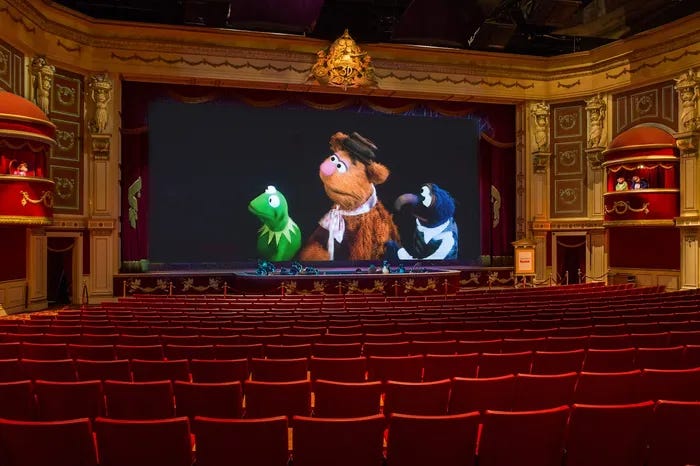
It’s official: Muppet*Vision 3D is closed. Enough digital ink has been spilled by Muppet fans and Disney park foamers mourning the loss of not only a classic Disney attraction, but also one of the last projects–if not the last project–Jim Henson touched before he died. I won’t add much to the bleeding ledger of ink, only to say that preserving MuppetVision1 in any way beyond moving the attraction itself2 would be a disservice to the experience. You can't adequately capture on video or VR what it's like to actually be in the theater. All the choices the attraction intentionally makes culminate in an integrated, multisensory viewing experience.
MuppetVision holds an important place in Disney theme park history. As I see it, it was Disney's first postmodern theme park attraction.
What do I mean by postmodern?
Postmodernism can encompass many different definitions. It can refer to the general period after modernity. Postmodernism is a philosophical movement. It's also a classification of literature, film, and art.
Postmodernism can be conceptualized as a response to the Modernist movement (which also contains different meanings and definitions–multimodal movements spanning several decades are often hard to pin down).
The core of Modernism focused on progress and order, on shedding traditional norms, beliefs, and values, and embracing technological and sociological advancement.
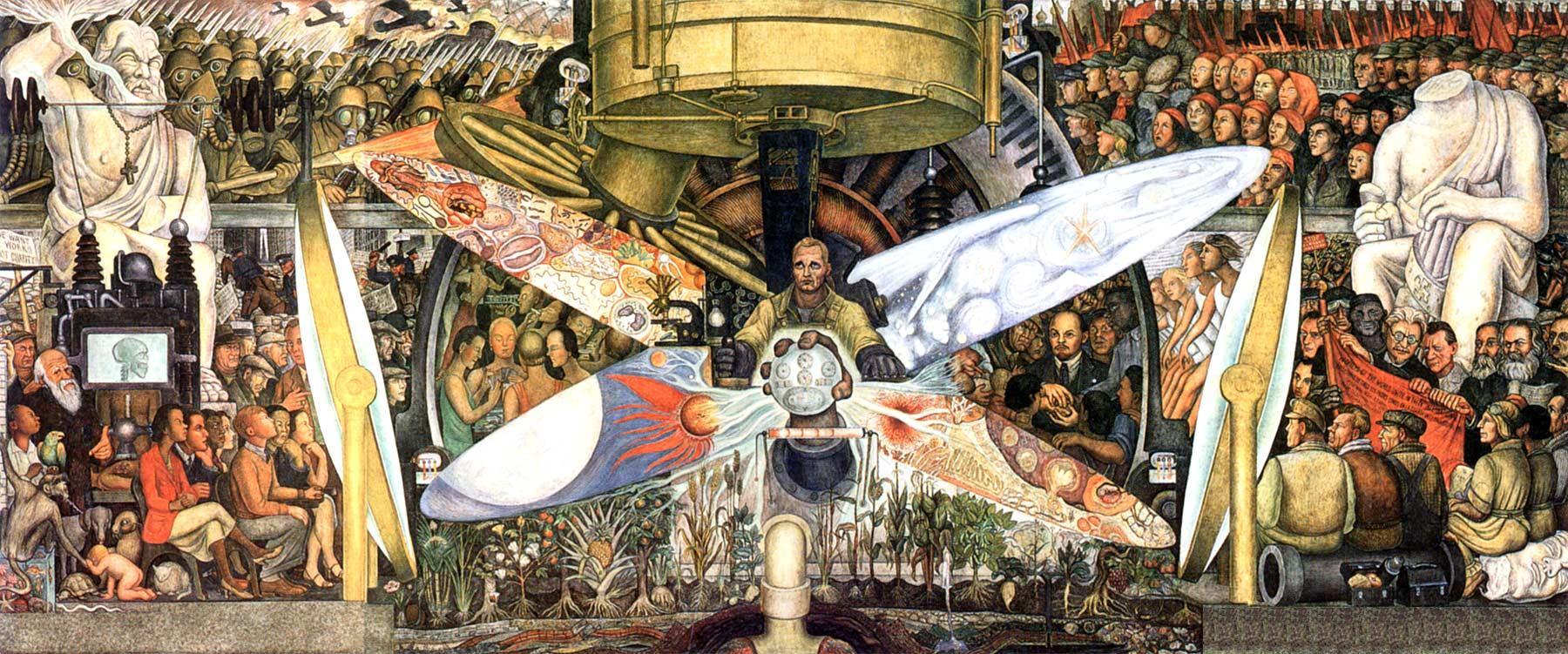
Take the painting Man at the Crossroads, an unfinished mural by Diego Rivera that is indisputably a better installation for 30 Rockefeller Center than what exists today. This has all the hallmarks of Modernist ideals–technological innovation, society breaking free from the confines of tradition, overthrowing historical power dynamics. Although this fresco doesn’t have the techniques commonly associated with Modernism like the abstract Cubism of Picasso, its subject matter and theme nails the Modernism zeitgeist.
Compare Man at the Crossroads to The Treachery of Images. While not completed during the postmodern movement, this simple painting of a pipe seeded the kernels for the postmodern era. The seemingly paradoxical statement is the message: the viewer is not seeing an actual, tangible pipe, but a representation. This playful, meta-irony would later become a cornerstone to the postmodern movement.
Modernism concerned itself with progressing into a glorious utopia and sought to redefine societal structures. Postmodernism takes a sledgehammer to Modernism’s ideals. It rejects meaning and ideals and truth altogether.
Postmodernism came at a time when artists were saturated with media: paintings, drawings, screenprints, literature, magazines, radio, films, television, cassette tapes, CDs–you get the picture. The work of postmodernists were inspired by, and were flung into, this potpourri media hurricane. As such, there was a tearing down of sorts with structure, narratives, and the separation of high art from lowbrow. Some postmodernists even focused their work on the act of consuming media and (ironically?) embraced hyper-commercialization. Look no further than Warhol’s Campbell’s Soup Cans for examples of the above.
Pastiche? Yeesh!
Now that we have a general, gestural gist of something resembling postmodernism, we can see how this applies to MuppetVision 3D.
Before guests even enter the queue for the attraction, Muppet*Vision 3D broadcasts its postmodern sensibilities with the added star in its name. You’d be forgiven if you theorized the excess punctuation was a cheeky meditation on Disney’s excessively verbose naming conventions and abuse of colons, dashes, and ampersands, but this attraction opened in 1991, far before this phenomenon began. Perhaps this is Jim Henson demonstrating preternatural comedy–providing the punchline years before the setup. Or perhaps the star/asterisk is a playful, meaningless vestige–an addition added just ‘cuz. The attraction name suggests this show doesn’t take itself too seriously.
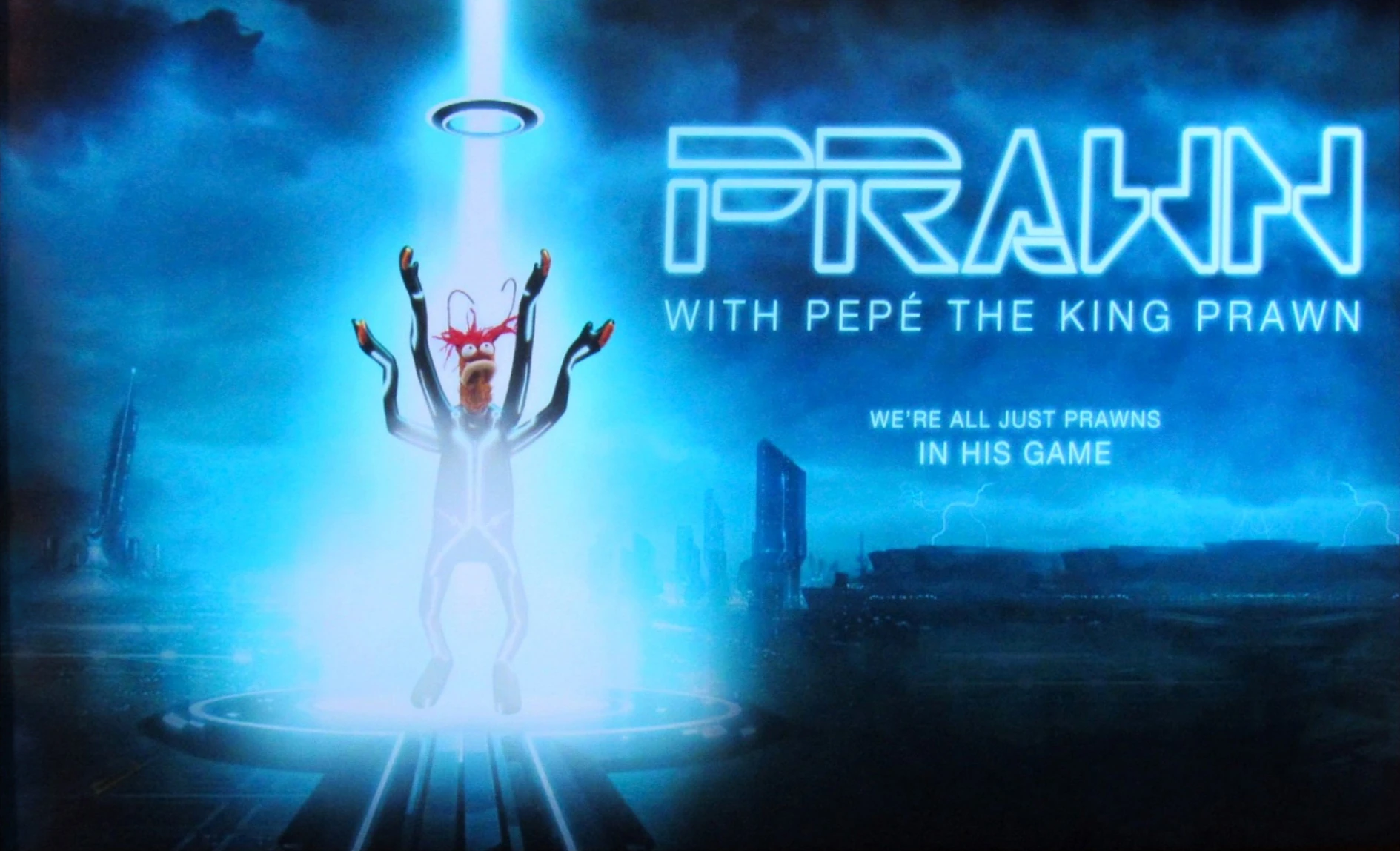
Within the queue guests are greeted with parody movie posters with Muppets humorously inserted, such as the Bride of Froggen-Schwein and Prawn. This use of pastiche is another tool of postmodernism–and wouldn’t you know it, pastiche also has multiple meanings (how helpful!). The first meaning is simply imitating or referencing another work of art, similar to the aforementioned movie posters. The second meaning is art taken or inspired by numerous sources–a remix of styles, techniques, and works.

This second type of pastiche is exemplified in the pre-show and beyond. After grabbing their 3D glasses, guests wait for the next show in a prop storage warehouse. In the center is a postmodern triptych: a cluster of 3 spaced TV screens displaying the pre-show video, which establishes the characters and story. Sometimes all 3 screens display the same feed. Other times, characters interact with other characters on the next screen or hop between screens. It is simultaneously remixing the theme park pre-show by not just being a laundry list of safety precautions or contrived set ups but an entertaining show unto itself while also deconstructing and elevating the screen and triptych medium.
By having the characters jump between screens, the pre-show draws attention to the negative space separating them. It brings the superficiality of theme park attractions to the forefront of a guest’s mind, making them aware of their viewing, intentionally preventing and rejecting total immersion that theme park attractions traditionally strive for.
It’s clear to guests at this point, before they even take their seat, that MuppetVision is a theme park show that’s aware it’s a theme park show.
Once the pre-show concludes and the doors open, guests are met with a gaudy theater replete with luxurious curtains, box seats, and bronze statues of Miss Piggy. High-quality decor for a low-brow show. It’s here that the media pastiche kicks into full gear, mixing and matching techniques from film, live theater performance, and robotics in order to create a wholly unique experience.
Oh, The Irony!
The attraction’s story is recursive and self-reflexive. Just as The Muppet Show is partly about how the variety program is produced, so too is MuppetVision 3D about the production of MuppetVision. Scottish literary critic Alastair Fowler dubbed this metafictional component of postmodernism poioumenon, when the story of a work is about the creation of the work.
This is highlighted by the Swedish Chef operating the film projector containing the meat of the attraction. Kermit and the gang document how the attraction and 3D effects are created while the projector is rolling, throwing into question how a film reel could exist with real-time interactions of the screen characters with animatronic figures and a live performer. MuppetVision obliterated the barrier between these different media types.
The entire experience has an aura of intertextuality, another postmodern staple, by reflecting on the theme park experience. A guest who has never before been to a theme park would be quite perplexed by the different elements of MuppetVision, but could still be entertained. It’s only when read within the greater tapestry of theme park attractions, and their requisite style, customs, and heuristics that the audience understands a deeper layer to the show. It is this intertextuality that enabled MuppetVision to spearhead postmodernism in the Disney parks.
There is no deep meaning or rumination in this story. It is another product in the clinical corporate machine of theme park management, and MuppetVision gleefully reminds the audience of this at every turn though ironic self-reference. The pre-show accomplishes this when Rizzo the Rat dons Mickey Mouse ears and pretends to be the big cheese himself, claiming the tourists in the audience won’t notice the difference.
The show continues its referential irony by satirizing theme park attractions' tendency to appeal to children in the form of the character Waldo, The Spirit of 3D. This annoying and zany balloon-animal-shaped entity with a gratingly childish voice—bordering on a lisp—skewers the sort of “engaging” cartoon characters that media companies put into various forms of entertainment to keep the attention of kids. It’s what 50-year old men in suits think 8 year-olds will find interesting.
And Waldo works as an effective foil for the show because the audience is familiar with these desperate caricatures that were proliferating around the time of the ride’s creation3. All this culminates in the tag at the end of the show wherein Waldo transforms into Mickey Mouse in a last ditch attempt at self-preservation (he’s quickly vacuumed up). This may appear as a throwaway reference joke at first4, but is really drawing a throughline from Waldo to Mickey. Mickey Mouse was the original Waldo, the inoffensive, slightly mischievous corporate mascot created to appeal to children. In a subtle way the show is transmuting the annoyances of Waldo onto Mickey. Without directly making fun of Mickey Mouse, the show asks: If you find Waldo insufferable couldn’t the same be said about Mickey?
Going Meta
We’ve already explored how the show uses metafiction, the show’s awareness of being a show, to its advantage. But one other metafictional component is the duo of Statler and Waldorf, the animatronic hecklers ported from The Muppet Show situated in box seats just outside the proscenium.
Statler and Waldorf are ostensibly viewing the show just as the audience is, yet they are simultaneously irreducibly part of the show. This adds an extra viewing layer to the show, as the two lob jeers like tomatoes, and the Muppets respond to their peanut gallery comments.
In fact, if we dig into it, there is a dizzying amount of layers of viewing going on throughout the show. Initially, the audience is watching Statler and Waldorf watching the Muppets being produced/projected by Swedish Chef. By the end of the show, the audience is watching Statler and Waldorf watching Bean Bunny watching Waldo watching the Muppets, produced by Chef, and scored by a raft of penguins.
The penguins, Chef, and Waldo then engage in combat, destroying the Matryoshka of viewing layers alongside the theater itself.
Through this, MuppetVision 3D has entered hyperreality.
The Hyperreality Hype
I’ll try to make defining hyperreality as short as possible. French philosopher Jean Baudrillard wrote a treatise called Simulacra and Simulation (most famous for appearing in The Matrix) which defines the following concepts (in my own words):
Simulation: A representation or imitation of something that exists in reality (think: a photograph, a self-portrait, a map)
Simulacrum: A representation that supplants reality or has no referent in reality Think: the save icon. Originally it made sense to represent the act of saving as a floppy disk. Most users needed to save their data to floppy disks due to limited harddrive capacity at the time. Since then, we’ve come a long way with storage media–CDs, high-capacity hard drives, flash drives, external hard drives, cloud storage–that have made floppy disks obsolete. Yet the icon remains, supplanting the actual reality occurring when you save your Word doc to OneDrive.
Baudrillard theorized that in our hypersaturated media climate, replete with hundreds or thousands of simulacra and simulations we encounter every day, the line between what is real and what is simulated begins to break down. This inability to determine the real from the simulated, or the lack of needing to determine this difference, is hyperreality.
We encounter this every day with our interactions on social media. TikTok/Instagram Reels/YouTube Shorts are saturated with creators providing a glimpse into their lives, holding a relationship with their viewers. Perhaps you share an affinity for some of these creators. You seemingly know them. Yet, none of it is real, the relationship, the videos. It all exists in a narrowed aperture, a carefully constructed and manipulated point of view. Collectively, these are hyperreality.
A similar comparison can be made to theme parks. Italian writer Eco labeled Disneyland the ultimate hyperreality. Disneyland is more real than real, an artifice without truth. Hyperreality has effectively supplanted actual reality when you enter the Disney bubble.
What the hell does any of this have to do with The Muppets?
MuppetVision is an attraction situated within the hyperreal theme park environment. Yet it functions as an additional layer of hyperreality within that environment. The attraction succeeds in lambasting the theme park hyperreality within its own hyperreality—what is “in universe” Muppet antics and what is simulated performances within that universe, quickly becomes indistinguishable.
At first there is a seemingly clear boundary: Kermit gives the audience a tour of their facility, Fozzie demonstrates some cheap 3D tricks, Beaker & Honeydew showcase the lab. But things go haywire when they unleash Waldo, culminating in Beaker sucking up the movie screen with a vacuum.
Thus begins the hyperreality comedy of errors.
After Miss Piggy performs a little song5, Bean Bunny exits a set door and literally leaves the film set, inhabiting a black void alongside Waldo. Yet curiously the projector is still on. We are seeing a movie of Bunny leaving a movie. Bunny then makes the leap outside of the film as an animatronic character. Sweetums makes a similar leap from the screen as a costumed performer.
All of this culminates in a glorious three hour finale6 where Muppet antics quite literally blow up the proscenium wall when the animatronic penguin orchestra open fires on Chef who retaliates with a canon and blows the theater to smithereens. Kermit then rolls in on a firetruck in what appears to be part of the Disney park outside the theater.
Muppet Vision is stuck in a deep hyperreality, tossing out the map and the territory alike. In blowing up the theater, it blows up meaning, references, and layers of viewing along with it, ultimately becoming a gonzo hyperreality extravaganza.
This is why trying to port the show outside of the Disney park environment is an effort in futility. It removes one layer of the hyperreality of MuppetVision. Viewing the show in a retrofitted theater or as a recording or as a VR experience dulls the show's edge, strips down one layer of meaning.
The postmodern substitutes for the earnest MuppetVision are attractions with glib snark and quippy one-liners.
These attractions lean on insincere, tongue-in-cheek irony, most of them Marvel Cinematic Universe rides or Ellen’s Energy Adventure7. But the cheeky referential irony of the MCU does not produce the same hyperreality of Muppet Vision because the MCU characters themselves never know they are in a movie or a theme park attraction8.
The MCU instead uses irony as an edge to keep the zanier comic book source material palatable for a mass audience. Characters are still unabashedly superheroes, but acknowledging weird names or odd powers invites the normie, non-comic-book audience along for the ride.
Contrast this with MuppetVision, which utilizes hyperreality to draw out sincerity. Amidst Muppet madcap mayhem and hyperreality mazes of simulations and referents with no source, the Muppet characters still support one another. They still try their best to put on an entertaining show. Although everything goes wrong and nothing makes sense, the Muppets persevere—always looking for the positive9.
With the closure of MuppetVision 3D, Disney is closing the book on several chapters of its legacy: the pre-Disney-acquisition stewardship of the Muppets, Jim Henson’s presence in the parks, Hollywood Studios losing its studio emphasis. It may be quite some time before Disney opens an attraction as weird and unique as this one–if they ever open it at all.
It’s amazing MuppetVision lasted as long as it did due to the ebb and flow of the Muppet’s popularity in those 34 years. It’s a testament to the timelessness of MuppetVision, whatever else was going on with the franchise, this attraction could still act as an anchor, a pillar where Jim Henson’s performance and ideas were still a living thing.
MuppetVision is raw, messy, wholly inimitable, and defies categorization, save one: a masterpiece of postmodern art.
ATTENTION PEDANTS! I will be using MuppetVision/MuppetVision 3D/Muppet*Vision/Muppet*Vision 3D interchangeably. You have been warned!
Perhaps a permanent installation managed by the Jim Henson Foundation?
and, let’s be honest, continues to this day
“Haha. They mentioned Mickey Mouse in a Disney theme park. Haha.”
Did I say little? I meant to say it’s a huge, show-stopping song!
Okay, more like a minute and a half
A fever dream of an attraction if there ever was one
Deadpool being the exception
“I do wish to assure you that no one was hurt, and, uh, this theater suffered only minor damage.”